


Leadership
Investments Help Rotorcraft Go Faster and Further
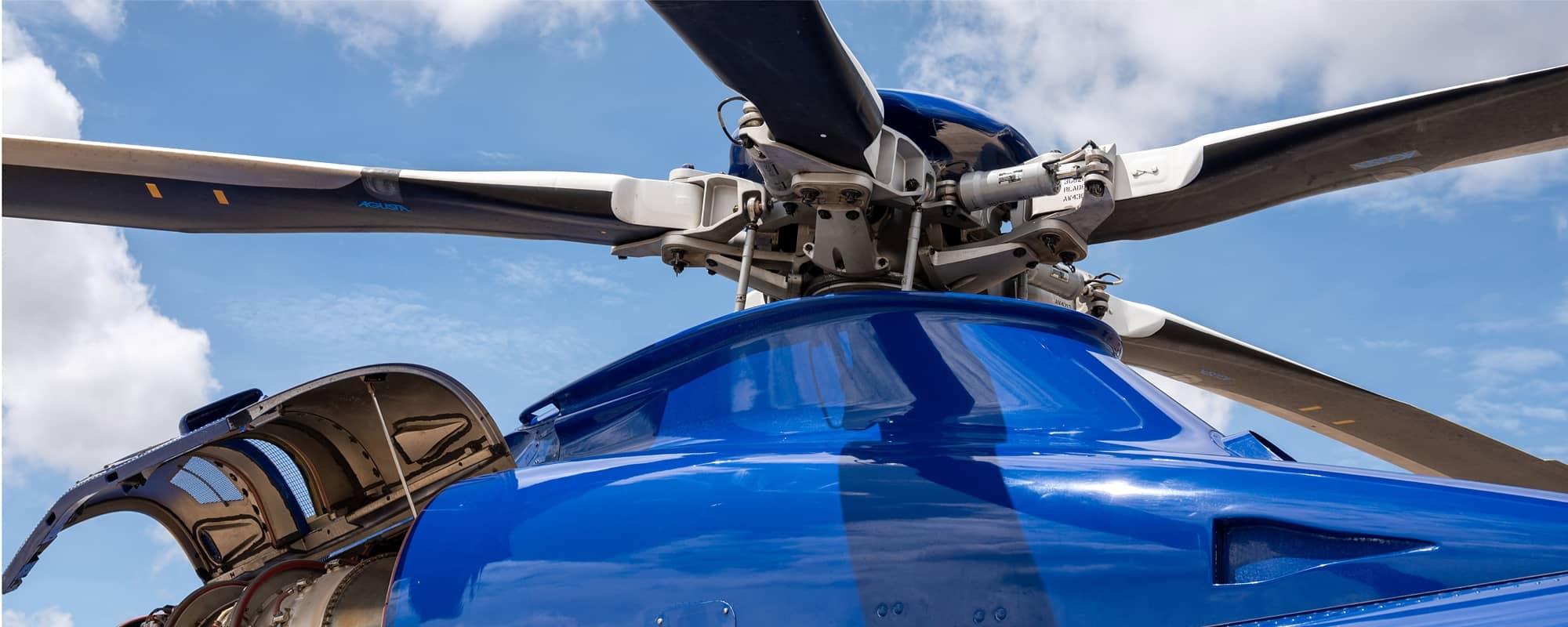
The helicopter is an engineering marvel. Like traditional aircraft, helicopters use aerodynamics to generate lift, but they rely heavily on the brute force of their rotating blades. Stop the blades, and a helicopter descends almost instantly. When it comes to weight, every ounce counts, not just to keep the craft in the air, but to ensure it has enough dedicated capacity for its primary purpose: safely and efficiently transporting the payload.
Today, rotorcraft original equipment manufacturers (OEMs) are looking to go faster and further with new designs. Timken helps them achieve those goals by investing in new technology and by never backing away from a commitment to understanding what customers need and how to deliver it.
Timken investments help keep aerospace customers on the leading edge in every sector:


Eighty years of advancing the helicopter
In the 1940s, Timken engineers worked closely with Igor Sikorsky to help bring his dream to life. The Sikorsky R-4 was the first helicopter to be sold in high volume, its maneuverability giving the world a powerful tool for performing rescue missions.
Timken supplies bearings for nearly every position on today’s rotorcraft platforms. “There’s a deep respect for rotorcraft customers that permeates our plants,” says Dave Dechellis, who manages the facilities in New Philadelphia and Gambrinus, Ohio.
Rotorcraft is a long-standing Timken market, but a constantly changing one. “We see a groundswell of energy around moving faster and more collaboratively,” says Seun Craig, aerospace sales account manager. Customers are asking for much shorter timelines — in one instance, engineering a new gearbox from design to delivery in 18 months.
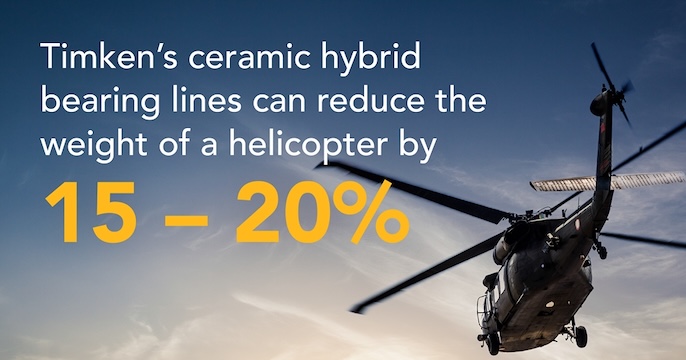
New platforms are pushing higher horsepower engines that require rotorcraft to fly faster, carry more load, and operate in more challenging environments. Timken’s hybrid roller bearings support these new designs efforts by providing mass optimization (~15-20% reduction in total bearing weight), debris resistance, and the ability to operate in higher temperatures. “Rotorcraft customers are all over hybrids,” says Craig. “Platforms are increasingly spec’ing in hybrids where feasible — and they’re looking to us for design expertise.”
Customer-driven investments
Timken engineering expertise has always been a major advantage for rotorcraft customers, who consider Timken’s application engineers to be extensions of their own design teams. Service engineering also plays an important role, going on-site to solve customer problems when they arise.
“There are about 30 different roller bearing applications on a new helicopter, and we support all of them,” says Matt Carl, application engineering specialist. “Technical engagement is key. We have a technology roadmap specific to rotorcraft applications, driven by customer feedback.”
“There are about 30 different roller bearing applications on a new helicopter, and we support all of them.”
Matt Carl
Application Engineering Specialist
Capital investments often follow. “As customer specifications adjust to markets or needs, that’s where we invest,” says Dechellis. “Timken’s new ceramic hybrid bearing lines are fed and led from another U.S. plant, where we have the state-of-the-art expertise and grinding equipment.”
To help shorten lead times, the company regularly upgrades equipment and recently purchased advanced machining assets. “Our continued investment in our facilities and manufacturing technology helps us more efficiently serve the needs of our customers,” says Carl. One new asset operates autonomously and could produce complex rotorcraft parts, along with main shaft aircraft engine parts.
Today, customers can rely on Timken for more than just roller bearings. Newly acquired businesses, such as GGB and Aurora Bearing Company, add expertise and capabilities that make Timken a one-stop-shop for rotorcraft. “It’s a constant evolution, and we’re excited to share the full breadth of the Timken portfolio, because tapered, rod-end, spherical, journal bearings — you name it, they’re in rotorcraft,” says Craig. “With each acquisition we’re expanding what we can offer aerospace customers — and the market.”


Timken technology plays a vital role for the helicopters that are critical for battling wildfires all over the world. Read more.
Last Updated: 2025/11/21
Published: 2025/08/18